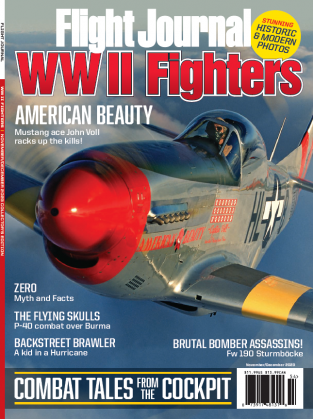
Dark Blue – Royal Navy Corsairs – the first to fly from carriers


The Royal Navy operated over 2,000 F4U Corsairs during World War Two. It was flying them from aircraft carriers when the U.S. Navy had declared the aircraft unsuitable for deck operations.
“Of all the aircraft I had seen, it was the most wicked-looking bastard. It looked truly vicious. I saw no reason why a Corsair shouldn’t kill me and that day I sat down and typed my last will and testament.”
—Lt. Norman Hanson, RNVR 1833 NAS
(later Lt. Cdr. DSC), July 1943
Fighters for the Fleet Air Arm
At the start of WW II in September 1939, the British Royal Navy’s Fleet Air Arm consisted of 20 Naval Air Squadrons with just 232 aircraft. In the early part of the war, the Royal Navy’s fighter aircraft requirements were met by cumbersome two-seat designs, such as the Blackburn Skua and the Fairey Fulmar, on the assumption that the only opposition they would meet would be long-range bombers or flying boats. When actual operations, particularly in the Mediterranean, proved this to be a false assumption, the Royal Navy hurriedly adopted higher performance, single-seat fighter aircraft, such as the Hawker Sea Hurricane and the rather fragile Supermarine Seafire, both modified, hooked versions of RAF land-based fighters. However, neither of these types had sufficient range to operate at any great distance from a carrier task force.
During the early war years, the Royal Navy (RN) acquired some batches of American aircraft built for other countries, such as France, Belgium and Greece, which did not reach their intended buyers due to the German advances in Europe. Most notably, the Grumman F4F Wildcat, initially known as the “Martlet” by the RN, entered Fleet Air Arm (FAA) service this way, and on December 25, 1940, a Martlet from 840 Naval Air Squadron (NAS) was the first U.S. fighter in British service to shoot down a German aircraft.
The implementation of the Lend-Lease program, approved by the U.S. Congress in March 1941, allowed the FAA to acquire large numbers of American aircraft under the scheme. Among the aircraft procured this way were additional Grumman Wildcats and the later F6F Hellcat.
From June 1943, the FAA began to receive Chance Vought F4U Corsairs, both the F4U-1 and the F4U-1A variants, which were re-designated Corsair Mk I and Corsair Mk II in RN service. The Corsair was a very welcome addition to the FAA inventory, being a high-performance aircraft with the range needed for carrier operations. It was also robust and versatile, able to conduct ground-attack missions and anti-shipping strikes, as well as being a capable air-to-air combat aircraft for fighter escort and air superiority missions.
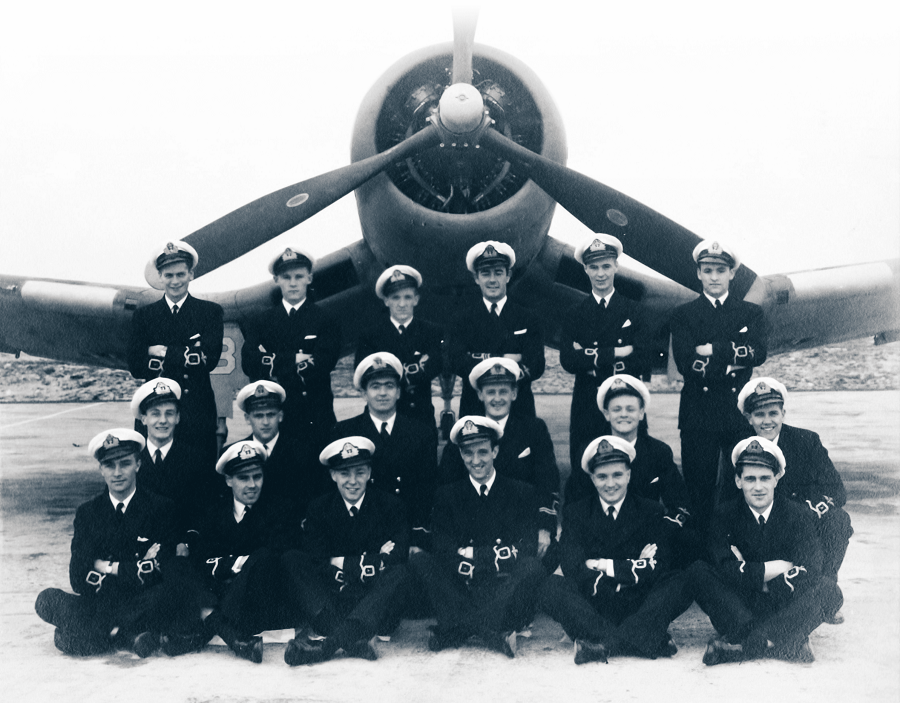
The Royal Navy Fleet Air Arm Corsair squadrons were formed in the U.S., either at NAS Quonset or NAS Brunswick. These are the 18 naval pilots who formed No 1846 Squadron in July 1944, photographed in front of one of their F4U Corsair IIs at NAS Brunswick. (Photo author’s collection)
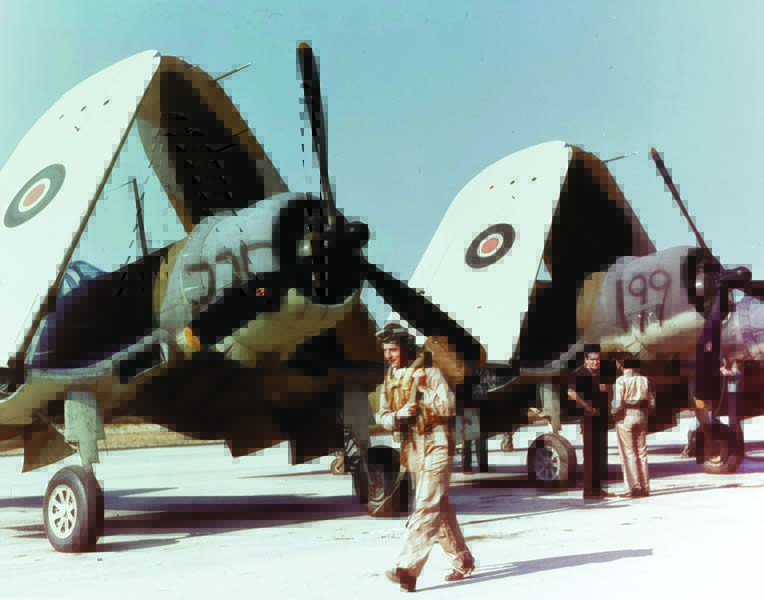
Royal Navy Fleet Air Arm F4U-1A Corsair IIs at Naval Air Station Quonset Point, Rhode Island, 1943. (Photo author’s collection)
The Royal Navy, however, needed the F4U as a carrier-capable fighter and put the Corsair into carrier operations almost immediately, well ahead of the U.S. Navy.
RN Corsair Squadrons
On June 1, 1943, No 1830 NAS was formed at Quonset US Naval Air Station, Rhode Island, as the first RN unit to receive the Corsair. Working under U.S. Navy supervision, RN personnel familiarized themselves with the Corsair, conducted carrier landing trials, and then embarked 10 Corsair Mk IIs on the escort carrier HMS Slinger in October 1943 for passage to the UK.
Seven more FAA Corsair squadrons became operational in this manner during 1943, either at NAS Quonset or NAS Brunswick.
Eventually, a total of 19 FAA Corsair squadrons were raised, and the Royal Navy received a total of 2,012 F4Us: 95 F4U-1s (designated Corsair I), 510 F4U-1As (Corsair II) from Chance Vought production, 430 Brewster produced F3A-1Ds (Corsair III), and 977 Goodyear produced FG-1Ds (Corsair IV).
Carrier landing problems
The United States had been operating the F4U Corsair since 1942, but the results of the U.S. Navy’s carrier trials with the aircraft in September 1942 had been disappointing, and the decision had been taken to issue the Corsair only to the U.S. Marine Corps for land-based operations.
The problems that were encountered during early carrier trials by both the USN and RN were exacerbated by the combination of the aft-set cockpit and the Corsair’s long nose, which severely restricted the forward view and made carrier landings hazardous, especially for newly trained pilots. It was also found that, during approaches to land, oil from the hydraulic engine cowl flaps could spatter onto the windscreen, further reducing forward visibility. If the airspeed was allowed to get even a couple of mph too slow during carrier landings, the Corsair’s port wing would stall and drop rapidly and without warning. In addition, if the throttle was advanced too rapidly at slow speed (during an aborted landing, for example) the enormous torque from the 2,000 hp, 18-cylinder, Pratt & Whitney R-2800 Double Wasp radial engine with its 13-foot-diameter propeller caused the aircraft to torque-roll violently, the port wing dropping so quickly that the fighter could flip right over. Not surprisingly, with such dangerous stalling characteristics, pilots tended to land well above stalling speed. The aircraft’s large wing then caused it to float along the deck in the final stages of landing, and the aircraft’s attitude meant that the tail hook was not close enough to the deck, making it more difficult to trap the arrestor wires. If pilots landed the Corsair firmly on the deck, it tended to bounce, as the undercarriage oleo struts had strong rebound characteristics, and this could also cause the hook to miss the wires. The aircraft also tended to swing on touchdown.
These issues made carrier landings hazardous using the U.S. Navy’s standard pattern, especially for newly trained pilots. The U.S. Navy declared the F4U unfit for carrier use until the various problems were solved, especially the wing-drop at the stall and the deck bounce. As a result, Corsair deployment aboard U.S. carriers was delayed until late 1944.
RN Corsairs on carriers
The Royal Navy, however, needed the F4U as a carrier-capable fighter and put the Corsair into carrier operations almost immediately, well ahead of the U.S. Navy. The British found the aircraft’s carrier landing characteristics just as problematic, suffering a number of fatal crashes, but they simply “bit the bullet” and did it anyway.
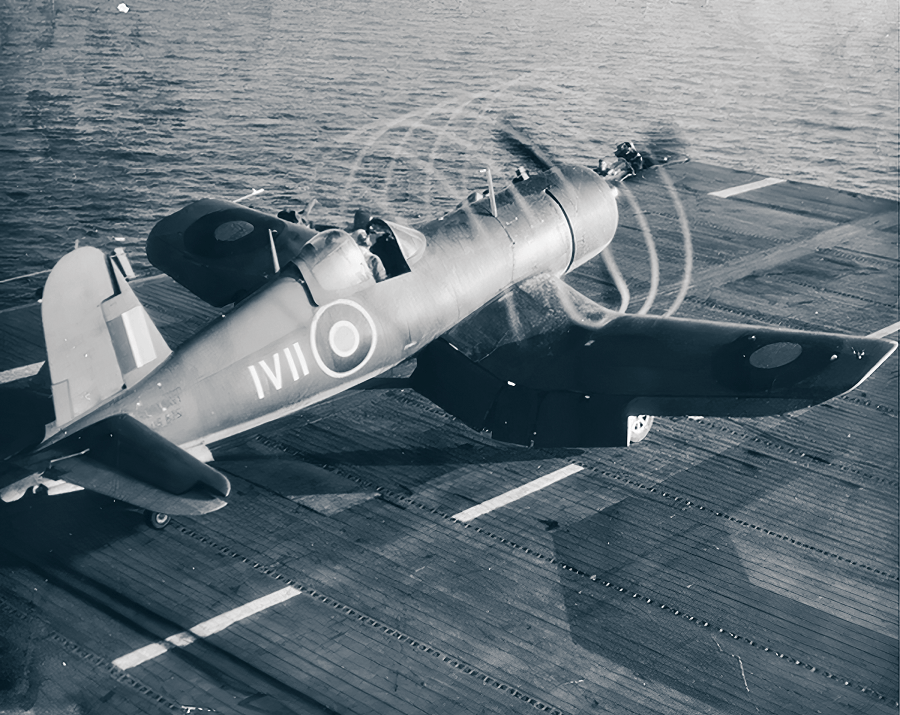
A Goodyear produced FG-1D Corsair IV, 1V11 of 1835 NAS, generates impressive vortices from the huge propeller on takeoff during a carrier training session. (Photo author’s collection)
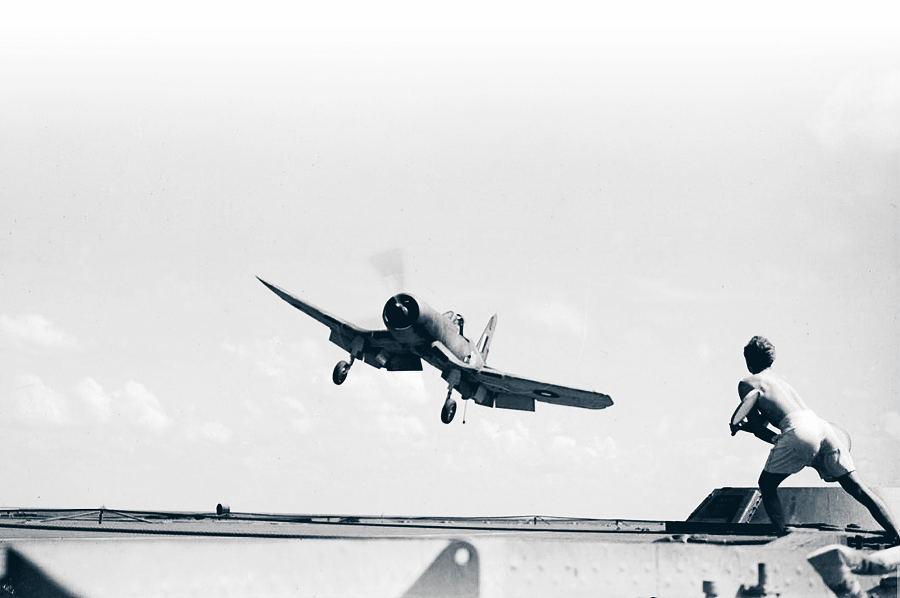
Demonstrating the curved approach needed for deck landings in the F4U, this FAA Corsair JT358, landing on HMS Illustrious in the Indian Ocean in May 1944, still has bank applied as the Deck Landing Control Officer signals the “cut” with his bats. (Photo author’s collection)
The FAA Corsair pilots found that they could overcome the visibility problem from the Corsair’s cockpit by approaching the carrier in a gentle left-hand turn, allowing the pilot to keep the carrier’s deck and the Deck Landing Control Officer with his signaling bats in view over the dip in the gull-shaped port wing. This technique would later be adopted by the U.S. Navy and Marines for carrier use of the F4U. Although it sounds simple enough, the touchdown point that the pilots were aiming at was, of course, moving forward at a rate of knots, and any delay in initiating the turn would inevitably result in an undesirable prolonged straight-in element of the approach to land. A well-flown curved approach to the deck would actually have the Corsair crossing the carrier’s stern with a small amount of bank still applied, rolling wings level only just before touchdown.
To overcome the limited deck height in some of the British aircraft carriers and to permit the Corsairs to be stored in the hangar decks, the wingtips of FAA Corsairs were clipped by eight inches. This change in wingspan had two additional benefits: it reduced the F4U’s propensity for floating in the final stages of landing and also improved the aircraft’s roll rate. The Royal Navy also developed a number of other modifications that made carrier landings more practical. The original Corsair Mk I “birdcage” cockpit canopy was replaced with a bulged Malcolm Hood, which allowed the pilot’s seat to be raised by seven inches, giving better visibility over the long nose. The problem of oil on the windscreen from the cowl flaps was solved by wiring the top flaps shut, diverting the oil and hydraulic fluid around the sides of the fuselage.
Meanwhile, the aircraft manufacturer, Chance Vought, addressed several of the design issues. The temporary solution adopted by the RN of wiring the top cowl flaps shut was universally accepted and the top cowl flaps were later replaced with a fixed panel. The potentially lethal stalling characteristics were solved with the addition of a small, six-inch stall strip fitted to the leading edge of the starboard wing, just inboard of the gun ports, to make both wings stall simultaneously. Another small but useful modification was a longer tailwheel strut, which improved the pilot’s view over the aircraft’s nose on the deck. The undercarriage bounce took more time to solve but eventually a bleed valve incorporated in the oleo legs allowed the hydraulic pressure to be released more gradually as the aircraft landed.
The Royal Navy quickly proved that the Corsair Mk II could be operated with reasonable success even from small escort carriers, although problems with operating the big fighter from decks persisted with excessive wear of the arrestor wires due to the weight of the Corsair and the understandable tendency of the pilots to land well above the stalling speed.
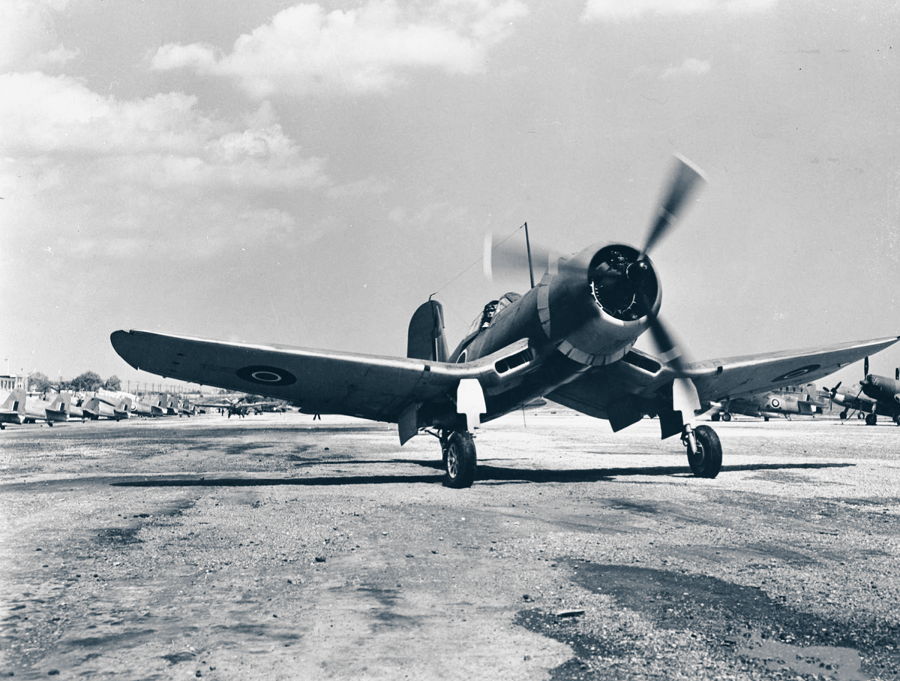
A Royal Navy Fleet Air Arm F4U Corsair 1 taxies at Roosevelt Field, Long Island, New York in 1943. The restricted forward view over the long nose from the aft-mounted cockpit is apparent in this view. (Photo author’s collection)
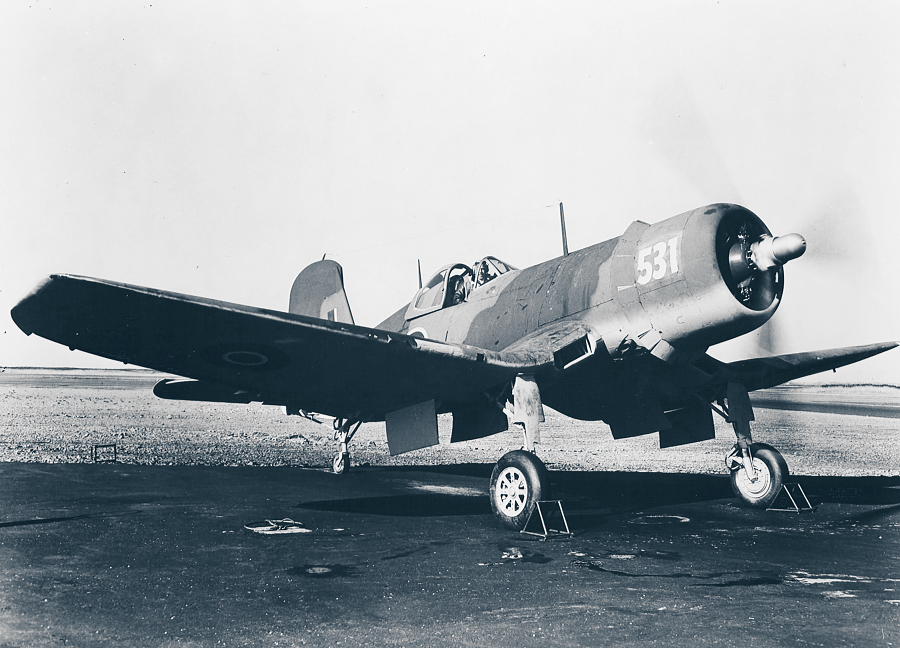
Royal Navy Vought F4U-1A Corsair II JT531 of 1834 Naval Air Squadron shows some of the modifications incorporated to improve the Corsair’s deck landing characteristics. It has the bulged Malcolm cockpit canopy, allowing the pilot’s seat to be raised by seven inches, and the lengthened tail wheel strut, both of which improved forward visibility. The wingtips are clipped by eight inches and a stall strip is fitted on the starboard wing to make the wings stall simultaneously. (Photo author’s collection)
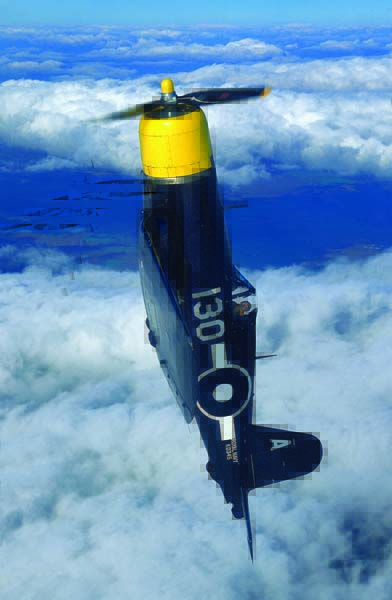
Goodyear FG-1D Corsair IV Specification
General Statistics
Span: 41 ft.
Length: 33 ft., 5 in.
Height: 15 ft.
Empty weight: 8,695 lb.
Gross weight: 11,093 lb.
Engine: Pratt & Whitney R-2800-8W Double Wasp 18-cylinder, twin-row,
air-cooled radial
Engine power: 2,250 hp at 2,700 rpm
Performance
Maximum level speed: 415 mph
Range: 1,015 miles
Ceiling: 37,000 ft.
Rate of climb: 3,120 ft./min.
Armament
6 x 0.5-in Browning M2 machine guns; up to
2 x 1,000-lb. bombs or
8 x 5-in. rockets
RN pilot carrier training
With the difficulties of landing the Corsair on a carrier deck in mind, it is interesting to note the story of Lt. Cdr. Richard Pridham-Wippell, the CO of 1837 NAS, who had taken over the unit after the previous CO had been killed in an accident. Pridham-Wippell had no previous experience of carrier deck landings. He described his first-ever carrier deck landings in an F4U Corsair from Quonset in his memoirs: “The great day, January 13, 1944, arrived and I led the first three aircraft out to the USS Charger. The ship appeared as a tiny speck in the middle of Chesapeake Bay and I remember thinking “Ye gods, how the hell am I going to put this thing down on Brighton Pier!” However, I followed the drill, Doug MacQueen—the Deck Landing Control Officer—gave a few corrective signals, and I caught an arrestor wire with a great sigh of relief. The aircraft was pushed back to the stern of the flight deck whilst I did my takeoff checks. On the second attempt, I was off line, so Doug gave the wave-off signal. I tried again. OK that time, followed by another two successful landings. Then I circled the ship whilst the other two pilots did theirs and we returned to Norfolk together. What surprised me was how smooth was the sensation when one caught a wire. There was no jerk; it was more as though a very strong man caught you by the jacket when running and pulled you back gently but firmly. What a relief—after 662 hours flying in three years, I had made my first four deck landings and had not scratched my paint!”
The business of landing the Corsair on a carrier deck never became something to be taken for granted, though, as evidenced by the experiences of 1845 NAS during pre-deployment deck landing training on HMS Slinger on January 4, 1945. Early in the training session, a Corsair failed to trap the wires and crashed into the barrier. Then disaster struck when Corsair KD546, flown by Sub-Lt. GA Anderson RCN, dropped its port wing on landing and slewed to port, collapsing the undercarriage leg, and crashed into the Deck Landing Control Officer’s platform, killing the DLCO, 22-year-old Sub-Lt. Fran Ure RNVR.

Carrier-deck landing accidents were commonplace. Corsair Mk II 132 of 1831 NAS missed the wires on landing and tripped over the barrier. It ended up inverted on the deck and the pilot, Lt. McKinnon, suffered a head wound. (Photo author’s collection)
Deck landing accidents
Crashes during deck landings were commonplace, and fatal deck landing accidents became almost an accepted hazard of wartime carrier operations. Many pilots and other Navy personnel were killed in such accidents and very many Corsairs were written off.
As an example, when the first RN Corsair squadron, 1830 NAS, joined the carrier HMS Illustrious for the first time in December 1943, four of its 14 Corsairs crashed on landing, one of them going over the side, killing the pilot, Lt. Cdr. Brian Fiddes DSO, 1830’s CO.
One particularly tragic case occurred aboard HMS Illustrious on March 11, 1944, when a Corsair of 1833 NAS, flown by Sub-Lt. Alan Vickers, crashed on the carrier’s deck while returning from a sweep over the Bay of Bengal. The wrecked aircraft came to rest with the engine on the flight deck and the tail on top of a pom-pom gun, with high-octane petrol pouring from it. Without hesitation, Sub-Lt. George McHardy, a Corsair pilot with 1830 Squadron who had himself only just landed on, and Sick Berth Attendant Ivor T Griffiths, who was a member of a party detailed for medical duties on the flight deck, rushed to rescue Vickers from his stricken aircraft as petrol streamed out of it, although both were well aware of the extreme risks that they were taking. Tragically, the aircraft caught fire and exploded while they were attempting to release the pilot. Vickers (the pilot) and Griffiths (the sick berth attendant) were killed instantly; McHardy died of his injuries the following day. Griffiths and McHardy were both posthumously awarded the Albert Medal for gallantry in attempting to save life at sea.
The Corsair pilots never got the chance to test their aircraft against German Luftwaffe fighters during these European combat operations, although trials were later flown against captured Fw 190s, with the F4U faring well.
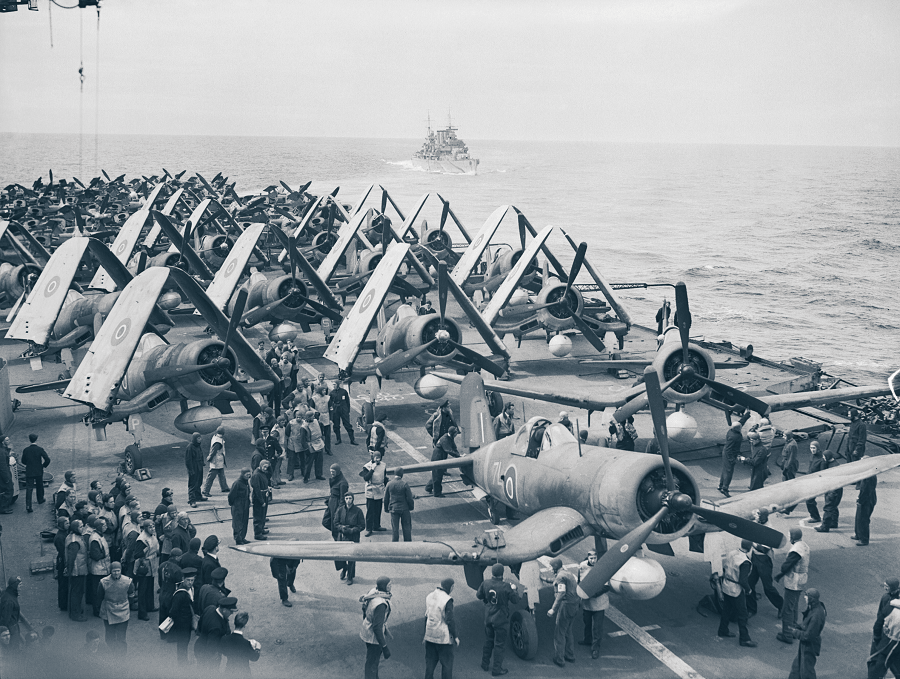
Corsairs of 1841 NAS being prepared on HMS Formidable for strikes against the German battleship Tirpitz in Kaafjord, northern Norway, during operation MASCOT on July 17, 1944. (Photo author’s collection)
Corsair operations in Europe
The first operational use of the Corsair by the Royal Navy was in Europe, during the important and strategically successful series of attacks in April, July and August 1944 against the German battleship Tirpitz, which was lying up in a supposedly impregnable anchorage in Kaafjord, northern Norway. Along with Hellcats and Wildcats, the Corsairs of 1834 and 1836 Squadrons from HMS Victorious provided top cover and fighter escort to the Fairey Barracudas assigned the task of attacking the battleship. On the first raid, the Tirpitz was hit by 15 bombs and badly damaged. As a result, she was incapable of putting to sea for several months during the crucial Normandy D-Day invasion period. Although they met no aerial opposition from the Luftwaffe on the raid, the attacking FAA crews faced a daunting barrage of flak. Amazingly, only one Barracuda was lost to anti-aircraft fire on this operation.
The Corsair’s contribution to the war against Germany was restricted to supporting the Home Fleet strikes against Tirpitz through to August and during this period, the Corsairs from HMS Victorious also savaged German shipping off the Norwegian coast.
The Corsair pilots never got the chance to test their aircraft against German Luftwaffe fighters during these European combat operations, although trials were later flown against captured Fw 190s, with the F4U faring well. A real confrontation between the F4U Corsair and the Fw 190 would have made for an interesting contest.
RN Corsairs in the Pacific
After their early European ventures, the RN Corsairs spent the rest of the war operating in the Indian and Pacific Oceans, fighting the Japanese.
In Europe, the FAA Corsairs had initially been painted in a Dark Slate Grey/Extra Dark Sea Grey disruptive pattern camouflage scheme on the top sides, with “Sky” undersides. In the Pacific, they were painted overall dark blue with a specialized British insignia—a modified blue-white roundel with white “bars” on both sides—intended to look more like the U.S. markings to avoid “friendly-fire” incidents.
The RN Corsairs combat debut in the Indian Ocean occurred in April 1944. Subsequently, Corsairs from the British Pacific Fleet took part in several major air raids in South East Asia against Japanese targets in Burma and Sumatra.
Many of the Corsair’s operations were ground attack or interdiction missions, bombing and strafing ground targets and enemy airfields, but some were fighter escort and fighter sweep missions. On July 25, 1944, during an operation against Sabang Island, RN Corsairs claimed seven Japanese fighters in aerial combat. These were the first of nearly 50 aerial kills by RN Corsairs and also the first deck-based victories for the fighter.
during an operation against Sabang Island, RN Corsairs claimed seven Japanese fighters in aerial combat. These were the first of nearly 50 aerial kills by RN Corsairs and also the first deck-based victories for the fighter.
On May 4, 1945, Sub-Lt. Don Sheppard, a Canadian pilot from Toronto serving with the Royal Navy, became the only FAA Corsair ace when his score rose to five enemy aircraft downed. Don Sheppard was on the strength of 1836 Squadron, aboard HMS Victorious, and his fifth kill was against a Japanese Navy “Judy” (Asahi D4Y Suisei). When he opened fire against it with his six .50-caliber machine guns, the enemy aircraft blew up in his face. He was going so fast that he flew through the flames of the exploding aircraft, burning the elevators and tail of his Corsair. Sheppard had previously shot down two Oscars (Nakajima Ki-43) in the East Indies strikes on January 4, 1945. He scored a kill on a Tojo fighter (Nakajima Ki-44) on January 24 and shared two kills on January 29. Five days later, on May 9, his carrier, the HMS Victorious, survived two Kamikaze hits in one day, but remained fully operational.
In July 1945, the British Pacific Fleet took an honored place on the right of the line of the huge U.S. Third Fleet, under Admiral Halsey, to participate in the final attacks on Japan. On July 17, 1945, a Ramrod of Corsairs from HMS Formidable and Fairey Fireflies from HMS Implacable attacked airfields at Sendai, Masuda, and Matsushima, about 250 miles north of Tokyo. They became the first British aircraft to over-fly the Japanese home islands. Later in the day, another Ramrod, led by 1834 Squadron’s CO, Lt. Cdr. J G Baldwin, DSC, took off from HMS Victorious and flew across Honshu to hit targets on the Japanese west coast. This was a period of intensive operations, during which the Corsair pilots were each flying more than seven hours a day, ranging widely over Japan to attack ships, harbors, airfields, and rolling stock. Inevitably, there were casualties. 1841 NAS, for example, lost eight pilots during this final period of the war.
Sad end
On V-J Day, August 15, 1945, with the war in the Far East at an end, the Royal Navy’s Fleet Air Arm operational employment of the F4U Corsair also came to an end. Eight of the 18 carrier-based FAA Corsair squadrons had seen combat; flying intensive ground attack/interdiction operations and claiming 47.5 enemy aircraft shot down.
Under the terms of the Lend-Lease agreement, the Corsairs either had to be paid for or returned to the U.S. As the UK did not have the means to pay for them, the Royal Navy Corsairs were pushed overboard into the sea in Moreton Bay off Brisbane, Australia—a sad end for such magnificent machines that had played an important part in the overall victory.
Flying the Corsair from carriers—RN pilot reports
Peter Jupe, 1848 and 1834 NAS
“It wasn’t an easy airplane to fly until you got used to it. The problem was that the pilot sat on the equivalent of the trailing edge of the wing. When you had it in level flight, you had 17 feet of nose in front of you and, of course, it being a radial, it didn’t taper off like, for instance, a Spitfire. So, when you came to land on a carrier, as you straightened out of the final turn to land and pulled it up into the three-point attitude for the landing, you could see absolutely nothing ahead. You couldn’t even see the ship let alone the batsman, the deck control officer with his bats telling you what to do, you couldn’t see him at all. Everything was blotted out by this enormous nose. Once you were committed to the deck, that was it.”
John Maybank, RNZN 1830 NAS
“American airplanes in the main had good visibility. The Corsair, unfortunately, wasn’t one of those airplanes. Consequently, you had to approach the deck at an angle, whilst adopting a sort of tail down approach. You had to be sinking down and turning at the same time so that you turned onto the carrier virtually as the batsman gave the ‘cut’ signal. You had to land about 2 mph above stalling speed in a Corsair; even so you were landing at about 88 to 90 mph. So, it was roll in, left wing down, straightening up at the last moment. By that time the batsman was nearly abreast of you, so you could see him and he gave you the ‘cut.’ It was a bit hairy to begin with, but you got used to it. On takeoff from the carrier, you opened the throttle as blind as a bat because you couldn’t see what was in front of you. Then you had to bring the tail up, slightly nose-up because of that big propeller, and you just hauled her off. She was a delightful aeroplane to fly. Although it looked big, in the air it lost all of its weight and, of course, it had a very powerful engine.”
Timothy Adkin, 1850 NAS
“It was a dream airplane. The power was unbelievable. The propeller was 13 feet diameter, the biggest propeller ever in a fighter aircraft. It flew like a dream; the power was there and it was just a dream machine. The Americans refused to land it on carriers. We got over that by doing carrier landings in a curve right onto the deck, which was the easiest thing to do and presented no problems at all. You landed on the curve, almost landing on one wheel most of the time. It was the easiest thing; an absolute ‘dolly’ to land. We on HMS Vengeance were landing aircraft at about 15-second intervals, which you could only do if you were flying tight circuits.”
Corsair Victoria Cross
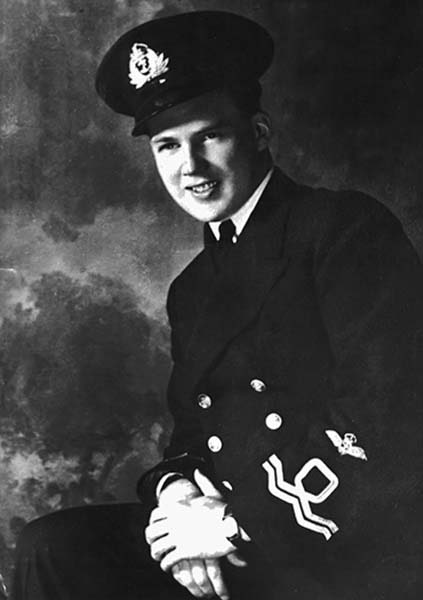
A few minutes after 8 a.m. on August 9, 1945, the day when the second atomic bomb was dropped on Nagasaki and only days before the war ended, Lt. Robert “Hammy” Hampton Gray, the “happy go lucky” Canadian senior pilot on 1841 NAS, led seven other Corsairs off the deck of HMS Formidable on the second Ramrod of the day. The captain of Formidable had asked his Corsair pilots to, “take it easy,” as he believed that the end of the war was probably only days away and unnecessary loss of lives should be avoided.
Gray was leading the first four-aircraft section in Corsair IV, KD658, which bore the code numbers “115.” The other four Corsairs were led by his deputy, Sub-Lt. MacKinnon. Each Corsair was carrying a pair of 500-lb. bombs, in addition to a full load of 0.5 machine gun ammunition. On arrival at the intended objective, a Japanese airfield, Gray realized that the target had been raided by other Allied aircraft and was already seriously damaged. Seeing no point in wasting bombs on an already crippled airfield, he elected to attack shipping that he had spotted enroute in Onagawa Bay. Diving from 10,000 feet and approaching from inland, trying to use the cover of the hills surrounding the inlet, Gray led the Corsairs down to very low level to attack the ships, planning to exit the bay toward the open sea. As the Corsairs flashed over the hills and into the harbor at 400 mph, a hail of anti-aircraft fire blossomed around and in front of them from dozens of guns on the hills and from the naval vessels at anchor. Gray pressed home his attack at less than 40 feet. His aircraft was hit and set on fire, but he released his bombs against the Japanese destroyer Amakusa, scoring a direct hit. At least one bomb penetrated the ship’s engine room and triggered a massive explosion in the aft ammunition magazine. The Amakusa sank in minutes.
Sub-Lt. John Blade, who was part of MacKinnon’s section, dropped his bombs and emerged from the smoke and turmoil to see “Hammy” Gray’s Corsair to his right erupt in flames from its port wing root, jerk into a steep starboard bank, then with its wings ablaze roll onto its back and plunge at full power into the water. Gray was killed instantly. On the radio someone said, “There goes Hammy.” Jinking wildly through the flak, the remaining seven Corsairs reformed under MacKinnon’s leadership and launched another attack on other targets in the bay until their bombs and cannon ammunition were exhausted. On their return to the carrier, John Blade was forced to belly-land his Corsair as the hydraulics had been ruptured; he escaped injury and the others landed safely. The war ended six days later.
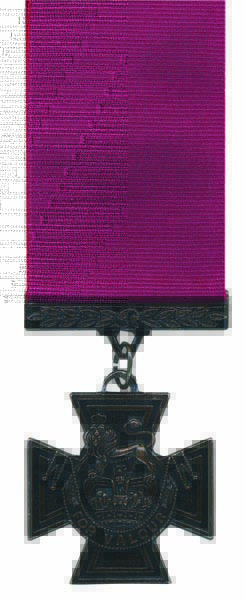
Robert “Hammy” Gray’s record of splendid leadership and personal example led to the posthumous award of the Victoria Cross (VC). The Victoria Cross is the British and Commonwealth services’ highest award for gallantry in the face of the enemy. Gray became one of only two members of the Royal Navy’s Fleet Air Arm to win the VC during WW II. The citation for Gray’s VC, first published in the London Gazette on November 9, 1945, included the words: “In the face of fire from shore batteries and a heavy concentration of fire from some five warships, Lieutenant Gray pressed home his attack, flying very low in order to ensure success, and, although he was hit and his aircraft was in flames, he obtained at least one direct hit, sinking the destroyer. Lieutenant Gray has consistently shown a brilliant fighting spirit and most inspiring leadership.”
BY CLIVE ROWLEY, MBE RAF (RET.)