Flying Bf 109 – The Historical View

The Bf 109 came about in very strange circumstances. On February 26, 1935, when the clandestine Luftwaffe officially came into being, it had already issued a requirement for a single-seat, high-speed fighter. This had been sent to three established aircraft manufacturers but not to Professor Willy Messerschmitt’s company. Nevertheless, Messerschmitt was eventually invited to submit a design, probably owing to the intervention of famous WW I ace Ernst Udet and the influence of Rudolf Hess, who was a lifelong friend of Willy Messerschmitt.

The Bf 109E was the first mass-production variant of the 109 series. By January 1940, it had displaced all previous models with 1,540 aircraft produced and 540 in Luftwaffe front-line inventory. The controls, however, became very heavy above 400mph, and this was a deficiency when it was in combat with the Spitfire, which had low, user-friendly, control maneuvering forces throughout its fight envelope. (courtesy of Warren Bodie)
A new fighter company for a new Luftwaffe
The Messerschmitt design was the unique Bf 109—a cantilevered, low-wing monoplane built of metal with a flush-riveted, stressed skin. The oval-section, monocoque fuselage had an enclosed cockpit; the single-spar wing had automatic leading-edge slats, and the inboard portions of the trailing edge carried slotted flaps. The narrow-track landing gear retracted outward into the wing, but the tailwheel was fixed. Although designed around the 610 hp Junkers Jumo 210A 12-cylinder, inverted-vee, liquid-cooled engine, the prototype was, unbelievably, powered by an imported 695 hp British Rolls-Royce Kestrel V. The first flight was made in early September 1935, and in October, it competed in the comparative trials of the four different fighters.
The second prototype flew in January 1936 with the Jumo 210A, and the third flew in June 1936. These models carried two .30-caliber (7.9 mm) machine guns above the engine cowl. In all, 13 prototype and preproduction aircraft were built before 1938; the main differences between them were armament, engines and propellers.
By autumn 1936, the choice for the new Luftwaffe fighter was between the Messerschmitt Bf 109 and the Heinkel He 112. As inspector of fighters, Lt. Colonel Udet was responsible for the final decision. He tested both types himself and found little to choose between them. He was, however, convinced that the angular and structurally lighter 109 would be easier to mass produce, so the die was cast. Although the test pilots at Rechlin Test Center preferred the Heinkel, the decision in favor of the Messerschmitt was made before their tests had been completed.
The race for speed is on
There then followed an extraordinary series of one-upmanship flights between the two competing companies. On November 11, 1937, Dr. Hermann Wurster—Messerschmitt’s chief test pilot—set a new world speed record of 384mph (620km/h) in a Bf 109 with an uprated DB 601A engine that could produce 1,650 hp for a very short period. Meanwhile, Dr. Heinkel had been redesigning the He 112 and had come up with the He 113, which, for some unknown reason, was redesignated the “He 100.” In the summer of 1938, Udet visited the Heinkel facilities in Warnemünde to fly the He 100, and on June 6, he casually increased the world speed record to 394mph (634km/h). On March 30, 1939, however, the Heinkel chief test pilot Dieterle reached 463mph (746.6km/h).
Meanwhile, Messerschmitt had designed the Me 209. This version of the 109 had been specially modified to break the world speed record, and chief test pilot Fritz Wendel did this on April 26, 1939, at Augsburg with 469mph (756km/h). The official world record book gives the record to an Me 109R (research) aircraft, as the Germans were keen to associate the top speed with their Luftwaffe fighter. Because the He 100 had made its record run at sea level and the Me 209 had flown over the much higher elevation of Augsburg, it had a 9mph (13km/h) advantage, and Dr. Heinkel said he intended to fly the He 100 at the same (higher) level. Udet, however, forbade any further record attempt, since the Nazis wanted the world to believe that the Luftwaffe had a world record-beater in service, which was, of course, far from the truth.
The first Bf 109B-1s with 635hp Jumo 210D engines and wooden propellers went into service in 1937, and in the same year, 24 109B-2s with 640hp Jumo 210Es and metal propellers were delivered to the Luftwaffe’s Condor Legion, which supported General Franco in the Spanish Civil War. The Bf 109C was similar to the 109B-2 but carried more armament; the D version made a significant change to the 960 hp Daimler-Benz DB 600A engine and an armament of two .30-caliber (7.9 mm) machine guns plus an engine-mounted 20 mm cannon that fired through the airscrew spinner.
Real production begins
The first major production version of the fighter was the Bf 109E (popularly known as the “Emil”), and it was powered by a 1,100 hp DB 601A with direct fuel injection and improved superchargers. Its engine no longer had a manual, supercharger-shifting mechanism that the pilot had to manage continuously to maintain maximum power as his altitude changed in combat. The Emil’s DB 601A engine had an infinitely variable, automatic, hydraulic supercharger transmission that completely relieved the pilot of that onerous duty. The pilot could now concentrate completely on the outside.
The first prototype for the Emil series appeared in the summer of 1938, and the first production aircraft were put into service in December of that year. By the outbreak of WW II (September 1939), the Luftwaffe had 1,060 Bf 109s of various types.
Willy Messerschmitt wanted to enhance performance by saving weight, and that meant compromising the plane’s structural strength. This resulted in accidents during training but was even more evident in operational service, in which the high G-loads of combat led to basic wing failures. Its major design weakness, however, lay in its narrow-track landing gear, which gave it a tendency to ground loop; that was exacerbated by the castering of the tailwheel in the ground attitude when the resultant ground loop could not be stopped with harsh braking and full deflection of the rudder. I feel certain, too, that the landing gear’s being slightly splayed outward aggravated the ground looping tendency and contributed to the excessive tire wear and bursts. The Spitfire had a similar, narrow-track landing gear, but it was not splayed out like that of the Bf 109, and the Spitfire didn’t show any ground-looping propensities. In 1939, these problems caused damage to 255 Bf 109s (only 14 percent were damaged during training). Sixty-three percent of the damaged aircraft were Emils, and as a result, a tailwheel lock was fitted to later models.
Another problem that arose in training was the difficulty encountered by young, inexperienced pilots in night flying. Owing to the Bf 109’s limited forward view and the tendency of its wing slats to snatch in and out near the stall, any flare to land that was held too long and made too high above the ground could result in a wing drop: in severe cases, this could end in a cartwheel when a wingtip dug into the ground.
Because of the frequency of the accidents, a tandem, two-seat, trainer version was eventually developed, and in mid-1945, I had the opportunity to fly this Bf 109G-12.
Once, I was foolish enough to fly it solo from the rear seat; my view for landing was virtually nil, and I had to make three passes before I arrived back in one piece—and this in broad daylight! This airplane must literally have been an instructor’s nightmare because the view from the instructor’s cockpit was by a periscopic sight—a case of the blind truly leading the blind.
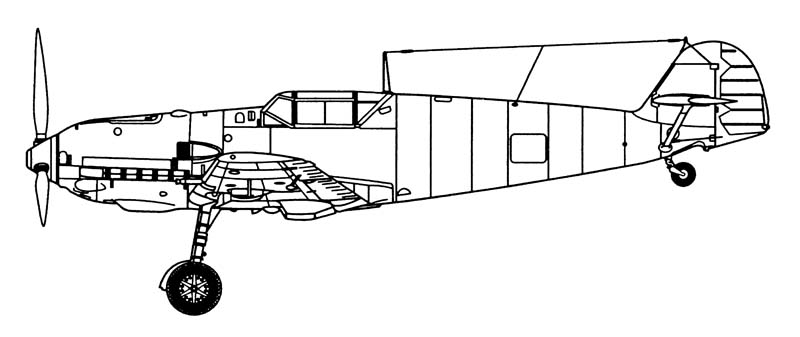
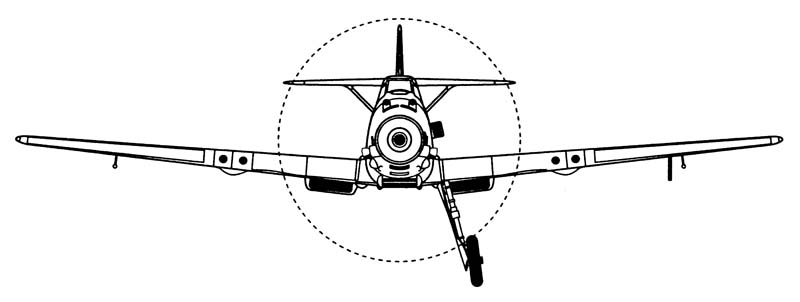
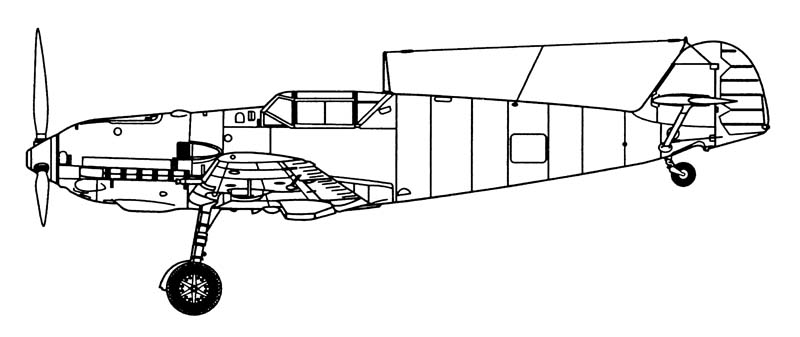
Messerschmitt Bf 109E
Wingspan: 32 ft., 4 in.
Length: 28 ft., 4 in.
Maximum speed: 359mph at 12,000 ft.
Powerplant: one 1,100 hp Daimler-Benz DB 601A
Armament: one 20 mm MG-FF/M cannon, four 7.9 mm MG-17 machine guns
WW II puts the Emil’s feet to the fire
WW II began well for the Luftwaffe against Poland and the Low Countries, where the German fighters rapidly established air superiority. Against France, they ran into potentially sterner opposition in the Dewoitine D.520, but France had too few for them to make any real impact. By early May 1940, the six British squadrons of Hawker Hurricanes in France had been increased to 10, and although they put up a good fight, they were not quite a match for the 109E in performance, firepower, or numbers. As they were withdrawn to Britain at the end of May, Spitfire Mk 1s appeared for the first time to cover the evacuation of British ground troops at Dunkirk. This new fighter must have come as a major shock to the Luftwaffe because up to 25,000 feet, the Spitfire could outmaneuver and outperform the Emil. The balance was not all in favor of the British fighter, however, because the 109E had superior firepower, performed better above 25,000 feet and could outdive the Spitfire.
The secret is out and its faults are found
While all this was happening, on November 22, 1939, a Bf 109E-3 made a forced landing at Woerth in France. It turned out to be an event of some significance. After being flight-tested by the French Air Force at Orleans/Bricy airfield, it was handed over to the RAF (Amiens, May 2, 1940) and arrived at RAE Farnborough, England, on May 14, for tests—a series of trials that lasted until September 20. These revealed valuable information about its strengths and weaknesses and were passed on to frontline RAF squadrons.
From the handling viewpoint, the Bf 109E had two pluses and four minuses. On the credit side, it had a steep angle of climb that made it difficult to follow, and it could also bunt into a dive without its direct-injection engine cutting out under the negative G, thus leaving a pursuing British fighter behind as its carburetor-fed engine faltered. On the downside, the 109 had poor harmony of control: no rudder trimmer, which meant it was easy to inadvertently pick up skid and ruin one’s sighting aim; in tight turns, the slats snatched open, giving lateral twitching and again ruining the pilot’s aim. Finally, when the speed was allowed to build up rapidly in a dive, the elevators became increasingly heavy until at 440mph, they became virtually immovable.
This timely analysis of the Emil’s handling was made available to the RAF before the Battle of Britain, and it stood the British pilots in good stead because they were up against some experienced pilots who had fought in the Spanish Civil War. The Bf 109E acquitted itself reasonably well in spite of its escort duties (it was assigned to protect the slower German bombers) and the psychological effect of fighting over enemy territory at almost its extreme radius of action. Its stablemate, the Bf 110, was, however, proving useful in the escort role but was a failure as a fighter/bomber, and this resulted in some of the E-series being fitted with bomb racks that could be jettisoned, much to the dismay of their pilots.
In fact, the Bf 109 later proved itself a useful fighter/bomber in conflicts such as in the May 22, 1941, Battle of Crete, in which the British cruiser Fiji, escorted by destroyers and withdrawing to Egypt, was severely damaged by a 109E carrying a single 500-pound bomb. The German pilot then summoned another Emil fighter/bomber that scored a direct hit and sank the cruiser.
Mother Russia and North Africa meet the Bf 109E
In June 1941, the 109E figured prominently and with great success in the invasion of the Soviet Union and became associated with the highest-scoring of all fighter pilots, Erich “Bubi” Hartmann (352 kills). With the onset of the Russian winter, it was subjected to the harshest of environments, and its serviceability did not match that of the Focke-Wulf Fw 190. It also showed itself vulnerable to landing problems on Russia’s uneven airfields and airstrips.
In early fall 1941, the Emil was subjected to the other end of the climatic scale when a unit equipped with the Bf 109E-4/Trop was based in North Africa. Again, this ubiquitous fighter became closely associated with the most famous German pilot of the North African campaign: Lt. Hans Marseille. Before his untimely death at 22 years of age, Marseille shot down a record 158 aircraft—all flown by British pilots—in less than two years of combat.
The 109 reacted better to heat than to cold, but the Daimler-Benz engine was prone to overheating if running up or taxiing was prolonged.
The Bf 109 was the most prolific fighter aircraft, but was this because it was an aerodynamic masterpiece or because of political decisions? An analysis of its aerodynamic efficiency shows high skin-friction drag and high drag of its exposed parts, especially those of the engine. Politically, the Nazis had a very short time from rising to power to implementing their aggressive plans, so a rapid buildup in Luftwaffe fighter strength was necessary to ensure air superiority, and the Bf 109 was highly suitable for mass production. Proof of this is evident in that the Luftwaffe had only 171 Bf 109s a year before the outbreak of WW II yet had 1,060 a year later.
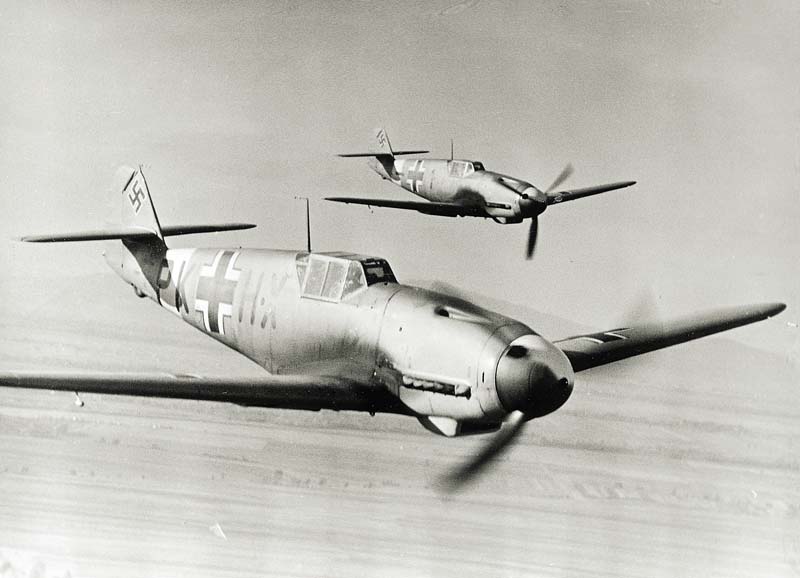
The Bf 109F was fitted with a more powerful DB601 engine in a new symmetrical cowl, and modifications were also made to the supercharger and radiator intakes. The 109F was also fitted with a new cantilevered tailplane, rounded wingtips, a smaller rudder and a fully retractable tailwheel (courtesy of Warren M. Bodie).
Flying the Emil
Now let me give my impressions of the Bf 109E purely as a flying machine and taken in the context of its time scale. It was the Luftwaffe’s first-generation monoplane fighter, and to any pilot weaned on highly maneuverable but rather slow biplanes, such as the Hawker Fury and Gloster Gladiator, it was a revelation in speed and rate of climb and an exciting handling experience. The roll rate and acceleration in the dive were notable for that era, and the power and flexibility of the direct-injection engine were truly exhilarating, particularly in aerobatics.
However, all was not sugar and spice. The cockpit was claustrophobic in the extreme, as it was small and narrow and was enclosed by a cumbersome hood that was quite difficult to open from the inside. Once settled in the cockpit, I became very aware of the characteristic smell that pervaded all German aircraft; it somehow reminded me of almonds and was strong but not sickly.
The reflector gunsight was very intrusive in that cramped environment and was heavily padded (obviously, for safety). The forward view on the ground was terrible, so on takeoff, I was advised to raise the tail as quickly as possible. This could be done fairly abruptly without fear of the airscrew hitting the airfield surface because the inverted-vee engine’s high thrust line gave ample clearance. The airplane had to be flown off, as any attempt to pull it off early resulted in aileron snatching because the wing slats opened unevenly. For this reason, to shorten the takeoff run, 15 degrees of flap were recommended.
Once the Bf was airborne, the main wheels retracted quickly, but the electrically actuated airscrew pitch-changing was slow. The flaps were raised manually by means of the outer of two concentrically mounted wheels to the pilot’s left; the inner wheel adjusted tailplane incidence. Thus, the wheels could be moved simultaneously to counteract the trim change as the flaps came up. The climb was at a steep angle; stability proved excellent in the longitudinal and lateral planes and was almost neutral directionally. Control harmony was poor because the rudder was light, the ailerons moderately light and the elevators extremely heavy. Control harmony in a fighter should be achieved with light ailerons, slightly heavier elevator, and the rudder heaviest.
An airplane’s stalling characteristics tell a lot about its “inner self,” and the 109 was no exception. At about 20mph (30km/h) above stall speed and with the aircraft “clean,” the stall was preceded by elevator stick buffeting and the opening of the slats; this was accompanied by unpleasant aileron snatching as the slats opened unevenly. The stall itself was fairly gentle: the nose fell off, and the left wing dropped about 10 degrees. These characteristics were accentuated in the landing configuration.
The landing approach was quite steep, but elevator felt very positive, which was just as well, for a substantial change of attitude was called for in the flare before touchdown. Even after ground contact, the lift did not spill rapidly, and on rough terrain, ballooning or bouncing were common.
Flying formation was easy with the crisp ailerons, rather heavy elevators and good engine response to throttle movement. Aerobatics, however, were more difficult because of the elevator heaviness and the slat snatching at the top of loops; this was often remarked on by young student pilots captured and questioned at the end of the War, and all were critical of the aircraft’s landing idiosyncrasies. It must be remembered, however, that pilot training in Germany during WW II was neglected to an incredible degree, as the pilot schools were directly subordinate to the air fleet commanders, who regarded the instructors as reserve pilots there to top off frontline units. The effect was that by 1944, Luftwaffe fighter pilots were being sent into combat with only 160 hours flight time whereas their British and American counterparts had 360 and 400 hours, respectively.
I was not overly impressed with the Emil, and yet it has earned a considerable stature in the eyes of many aviation historians and has charisma in the minds of many Luftwaffe pilots. This reputation rests mostly on its superiority to its mediocre—and often downright inferior—opposition, especially on the Eastern Front, where the German pilots outshone the Russians’ tactics— although not their courage—and amassed huge kill scores. I know only too well how easy it is to get emotionally involved with an airplane in which you have fought and survived and to regard it with the same uncritical affection as a mother has for her child. But, when you’ve flown a wide range of other fighters and become more analytical, your views are soon tempered by reason. Certainly, the Bf 109E was a good workhorse, but it was not a thoroughbred like the Spitfire and Mustang.
The RAF is given a Gustav—gratis
Although the Emil was a very prolific version of the Bf 109 series, the most produced version was the 109G, or “Gustav.” On July 21, 1944, a Bf 109G-6/U2 landed in error at Manston Airfield in the southeast of England and was at once transferred to RAE Farnborough, where the test pilots gave it a thorough flight assessment; it was also assessed from engineering and armament standpoints.
To me, the Bf 109E always looked sinister, but the Gustav seemed less so by virtue of its rounded wingtips, cantilevered tailplane and the Galland clear-vision cockpit canopy that was added to the G-10 and subsequent variations. It was powered by a 1,475 hp DB 605AM and was armed with two .50-caliber (13 mm) fuselage-mounted machine guns (300 rounds per gun) and one 20 mm cannon with 60 rounds firing through the airscrew spinner. Other differences from the Emil were its smaller rudder and retractable tailwheel. These changes increased its loaded weight to 1,422 pounds and increased its wing loading; it was also more than 30mph faster and indeed could enhance its top speed significantly for a short period by using GM-1 nitrous oxide injection. I would like to have seen a more efficient method of operating the flaps, other than by the laborious winding of a large hand wheel, but this didn’t materialize.
At RAE Farnborough, despite our having a considerable supply of spares from the many 109s that crashed in England, we did not find our captured Bf 109G-6 easy to maintain. Part of our problem involved the electric systems used to actuate the ancillary controls; we were used to hydraulic systems. But there was also the poor quality of the rubber tires and the customary ineffective German brakes.
The armament of the 109 was of particular interest to RAE scientists, who agreed that the 20 mm cannon firing through the airscrew spinner—as introduced in the 109D—was a potent weapon, both with regard to destructive power and ease of sighting. This could not be copied in British fighters powered by Merlin engines, as these had a vee layout; the Daimler-Benz engines were inverted vee and so could accommodate the cannon between the cylinder head blocks. The later introduction of the 30 mm cannon in the 109G-6/U4 caused concern because of its formidable destructive power, but tests showed that if fired slowly, it was unreliable and inaccurate at ranges beyond 650 yards (600 meters). The 30 mm cannon was more suited to bomber interception than fighter-versus-fighter combat, so for the latter, it was replaced by the faster firing 20 mm Mauser cannon with 150 rounds.
The Bf 109 was heavily involved in two significant but vastly different operations that produced contrasting results. The first took place in Russia on July 5, 1943, when the Battle of Kursk developed into the largest and fiercest air battle of all time; 432 Soviet airplanes were shot down versus the loss of only 26 Luftwaffe aircraft. The second operation was in Germany on April 7, 1945, when 120 Bf 109Gs, piloted mainly by students, took off to intercept a USAAF raid with instructions to ram the bombers as a last resort. Of that German force, only 15 returned.
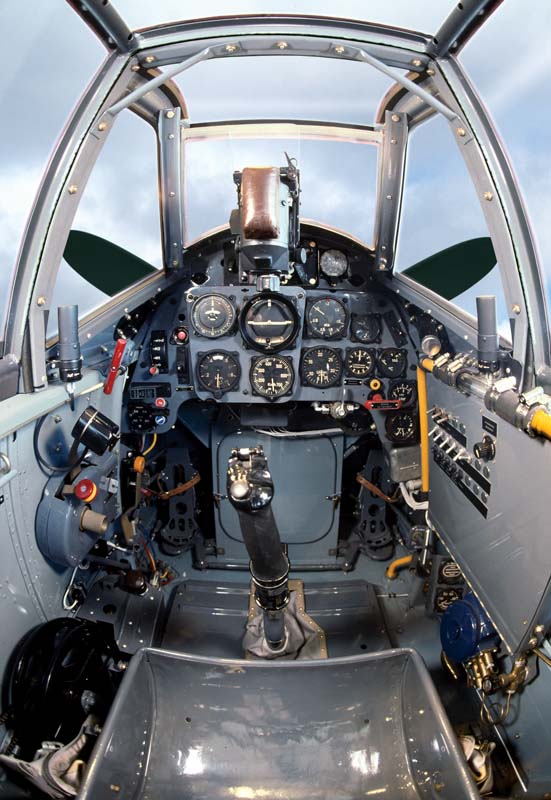
“Utilitarian” best describes the 109’s cockpit. As the heavily framed enclosure is lowered over your head, the feeling of claustrophobia is apparent. Power and flight controls within easy reach afford the pilot simplicity of form and function. The pilot’s legs straddle the MG 151 20mm cannon breech. photo by Brian Silcox)

The Gustav’s 1,475 hp Daimler-Benz DB 605 engine has been retrofitted to the Spanish-license-built airframe. In 1942, Spain secured the rights to build the Gustav, with cooperation from Germany providing tooling, instruments, drawings and Daimler-Benz engines. Because of the war situation, Germany never delivered, and the Ha 1112 “Buchon” flew with Hispano-Suiza V-12s and, later, Rolls-Royce Merlin engines. (photos by Brian Silcox)

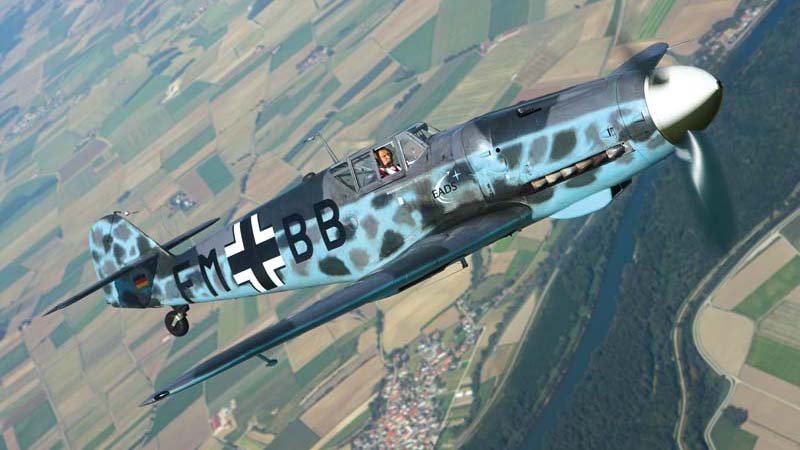
Messerschmitt Me 109G-6 over the Danube, Ingolstadt, Germany, Sept 2006, Walter Eichhorn pilot
Synopsis
The more than 33,000 Bf 109s produced from 1938 to 1945 gave the Luftwaffe an abundance of continuously updated air weapons. They were capable of beating their implacable enemies, even in the terrible conditions of Russia and North Africa. Many Luftwaffe Bf 109 pilots racked up scores in the hundreds that will dazzle the minds of air historians and fighter buffs for years to come.
But the Bf 109’s deficiencies almost equal its fabulous assets. The Luftwaffe lost 11,000 of these thoroughbred fighting machines in takeoff and landing accidents, most of them at the end of the War when they needed them most. The inexcusably poor visibility from the cockpit greatly reduced their pilots’ ability to fight. The snatching of the automatic wing slats not only caused many of the numerous ground accidents but also contributed to a great many aerial accidents. The slat, canopy, and landing-gear problems all had known, simple production fixes. Perhaps Prof. Willy Messerschmitt and the Luftwaffe generals were too busy patting themselves on their backs and counting Bf 109 victories to find time to listen to the pilots or to digest the significance of the Bf 109’s accident rates.
The Bf 109 was, indeed, a prolific, necessary and timely fighter but was not as great as the Spitfire, the Mustang or the Hellcat, which all had many fewer vices for the wartime pilots to overcome.