Elliptical Elegance – Flying and Evaluating the Seafire Mark III
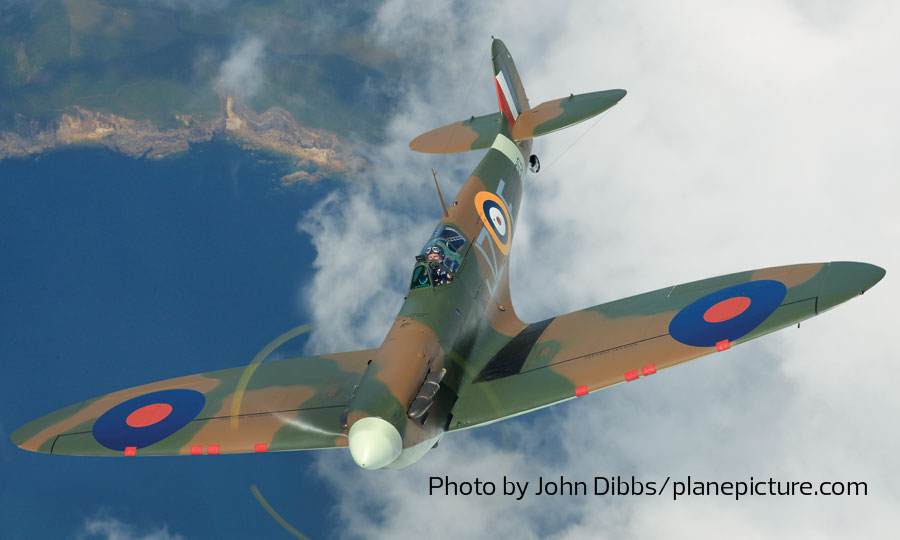

It’s commonly agreed that the Spitfire/Seafire configuration was the most beautiful fighter ever. Its elliptical wing and long, slim fuselage were most delightful to the eye, and its flight characteristics equaled its aerodynamic excellence. The Navy Spitfire, the Seafire, was heavier, but otherwise retained all of the Spitfire’s delightful flight characteristics.
Pictured above: The Comanche Fighters’ Spitfire/Seafire epitomizes the beauty that 1930’s aerodyamics can give an
airplane. (Photo by John Dibbs/planepicture.com)
The Spitfire and Seafire series had only two unacceptable features to perturb a fighter pilot: one was caused by its configuration, and the other was the result of gross negligence on the part of the design team. The length of its nose and the aircraft’s steep, nose-high angle provided insufficient forward visibility when taxiing. The slimness of the fuselage alleviated this problem somewhat, but continual S-turns while taxiing were mandatory. And the cockpit’s internal layout was a disaster! It was configured as if blindfolded engineers had played “Pin the tail on the donkey.” Important switches, instruments and controls weren’t labeled and were small and hidden. Unimportant items, too, weren’t labeled, but they were large and always in the way. So much for the objective evaluation. In reality, combat pilots would forget these drawbacks when airborne!
I was checked out by two soon-to-be-famous Royal Navy lieutenants: Mike Lithgow, who became chief test pilot of the Supermarine after the War and also became my good friend; and Peter Twiss, who became chief test pilot at Fairey Aircraft. On March 10, 1956, he set a world speed record in the Fairey Delta-2 by flying the first jet aircraft to exceed 1,000mph in level flight. Lithgow and Twiss were not only friendly check pilots but were also most helpful in getting me off the ground and back to the flightline.
On the flight before mine, the pilot reported that the brakes failed after landing. Inspection showed that the engine-driven air compressor that provided power for the wheel brakes had somehow leaked air, and the brakes failed while taxiing with the engine at low rpm. Twiss confidently asserted that they had filled the air accumulator and that it would provide enough braking to get airborne but it might fail after landing. He further stated that if I made a “docile” landing and taxied “peacefully” off the runway into the grass, they would come out with a tug and retrieve the aircraft. With such professional encouragement, I decided to give it a go. Evaluating the Spitfire was on the top of my need-to-do list at the Joint Army/Navy Fighter Conference in October 1944.
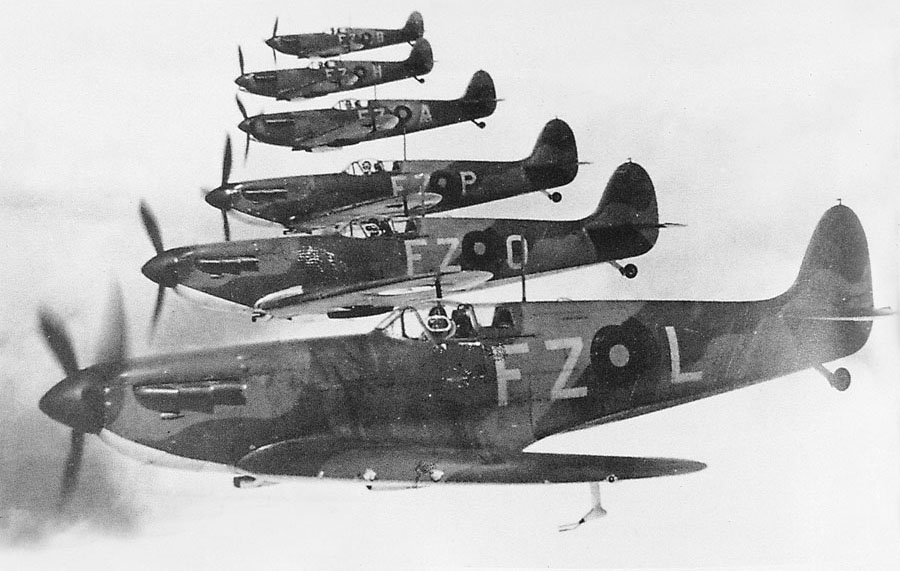
1939: An echelon of Spitfire Mk. Is flies over England. For the war, the peacetime echelon was revised into two pairs of Spitfires that were farther apart and flew in a step-down formation so that they’d be better able to support one another during fast combat maneuvers. Each was armed with 8w Browning .30-caliber machine guns and had a top speed of 362mph. They were capable foes of early Bf 109s but were soon outclassed by more powerful versions. (Photo courtesy of the RAF via author.)
This Mk. IX Spitfire with No. 133 Squadron markings has wing bumps for 20mm cannon, but they have not been installed. The Mk. IX had the “universal” E wing, which also had space for four .50-caliber guns. It had a 250-pound bomb rack on each outer wing panel and a fuselage rack for a 500-pound bomb; this made it an effective, but short-range, fighter-bomber. Some later ground-attack models had clipped wingtips, and that made the wing much stronger for evasive, ground-attack recoveries. (Photo courtesy of the RAF via author.)
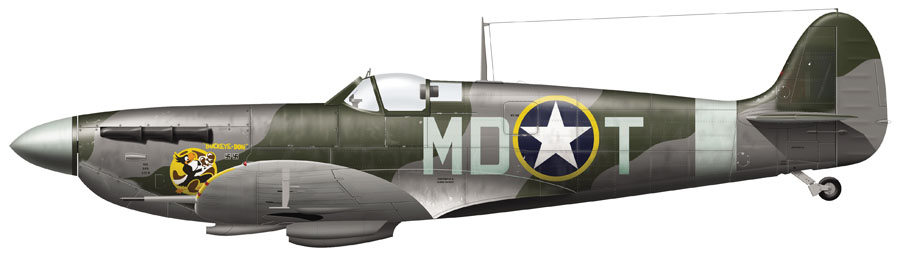
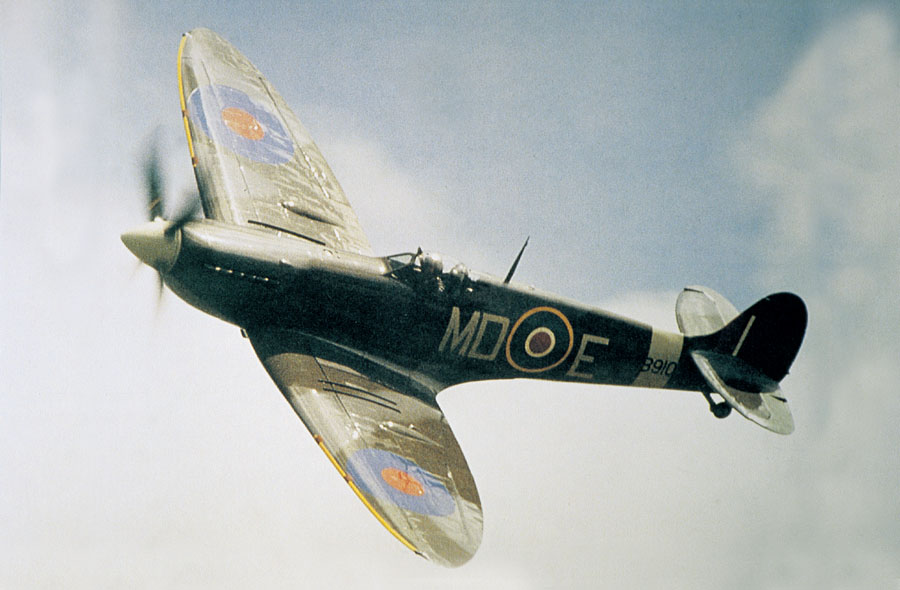
October 1942: Spitfire Mk. VB MD-T was flown by 336th Fighter Squadron, 4th Fighter Group ace Don Gentile out of Debden, England. (Illustration by Tom Tullis)
Because of the thrust of its 1340hp Merlin engine, its big wing area and immediate powerful rudder, its wheel-brake problem was soon out of my thoughts. The terrific, full-power takeoff acceleration of this light interceptor-fighter was thrilling. By raising the tail immediately, I could easily see ahead. The Seafire left the ground after less than 500 feet of roll into a 20-knot wind and climbed like a homesick angel. For the rest of the flight, I mentally blotted out all problems with this airplane. Straight stalls and turning stalls were friendly with very little wing dropping and at an unheard speed of 66mph! (The Hellcat had an 85mph stall speed.)
I did spins as though I was in a training aircraft, with instant recovery as soon as I released the controls. Even if I could have found the trim-tab controls, and I couldn’t, I had little need for them. The stability about the airplane’s three axes was low enough to make it a fighter pilot’s dream and high enough to fly hands-off in turbulent air—a great combination. Aerobatics were a pleasure. The airplane responded right after the thought of any aerobatic maneuver came into my mind—seemingly without effort. It was easy to see how a low-time pilot would easily be able to master this aircraft with confidence.
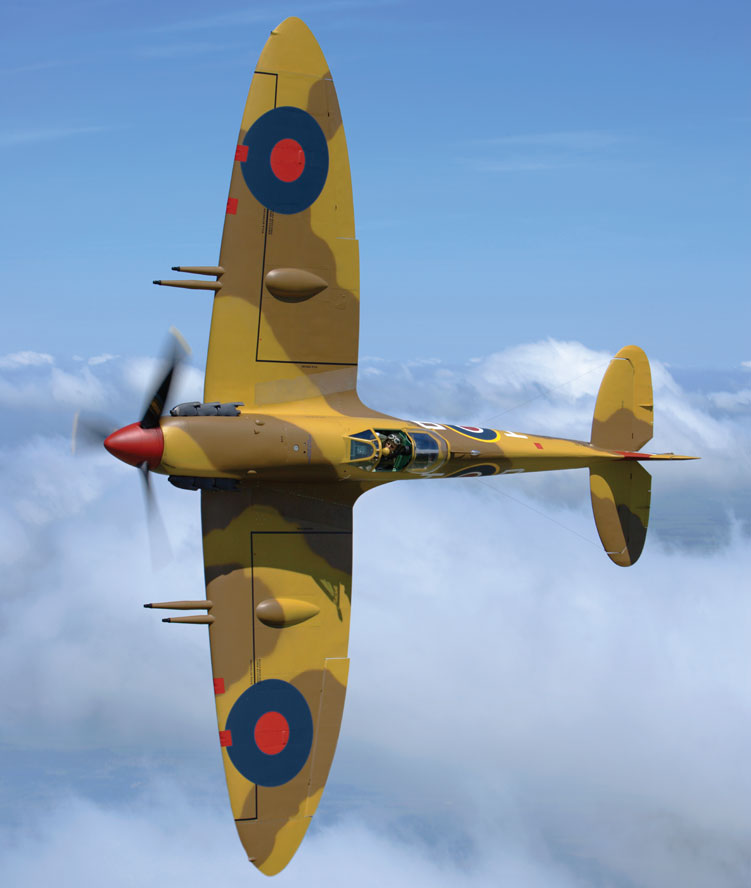
This Mk V Spitfire shows the lines that are unique to all versions of Spitfires and Seafires. (Photo by John Dibbs/planepicture.com)
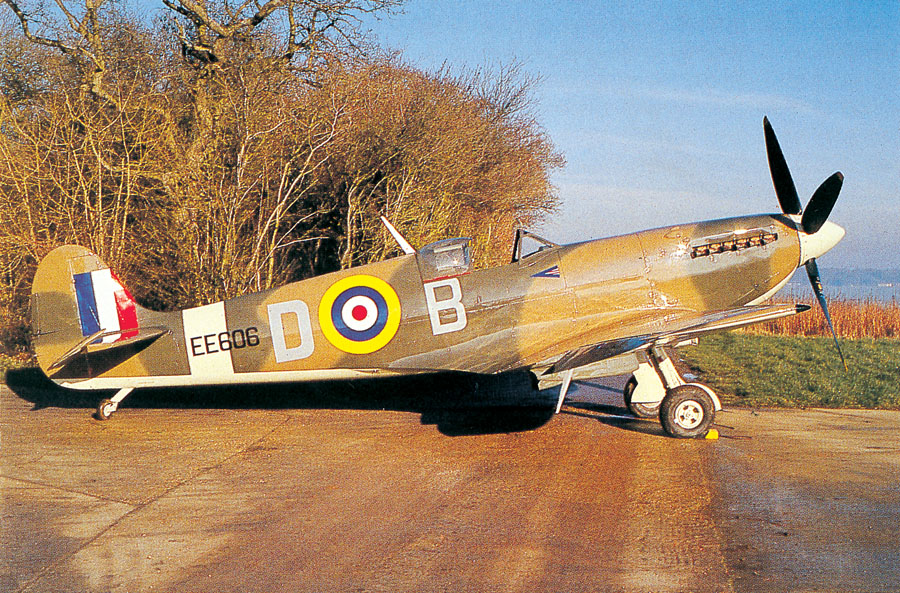
This Mk. VC Spitfire sports the colors of the famous RAF wing commander, Sir Douglas Bader’s aircraft. This well-known legless hero of the Battle of Britain was shot down over France in mid-1941 and taken prisoner. One of his wooden legs was lost when he parachuted, but the Germans allowed him to have a pair of good ones parachuted to him during a bombing raid. Although he tried to escape many times, he remained a captive until the end of the war, as is well documented in the 1956 movie, Reach for the Sky. (Photo courtesy of author.)
The Seafire had delightful upright flying qualities. Knowing that it had an inverted fuel and oil system, I decided to try inverted figure-8s. They were as easy as pie, even though I hung from the complicated, but comfortable, British pilot-restraint harness. I was surprised to hear myself laughing as if I were crazy. I have never enjoyed a flight in a fighter so much—before or since—or felt comfortable so readily in any aircraft and in any flight condition. It was now clear to me why so few exhausted, hastily trained, Battle of Britain pilots were able to fight off Hitler’s hordes for so long and so successfully. I eventually learned the meaning of Winston Churchill’s famous phrase honoring those overworked RAF heroes.
Alas, the gauge on my Seafire’s one and only, all-too-small, 122-gallon fuel system beckoned me to attempt a brakeless, “docile” landing without a ground loop. Like a martini high and by landing in the same 20-knot wind, it seemed as easy as everything else had been during the last delightful hour and a half. After a gentle landing, I gently and civilly nudged the rudder of my new Seafire Mk. III friend and taxied off the runway. It stopped peacefully as I had been told it would. I called the tower, notified them of my predicament and awaited my very kind, English test pilot friend’s arrival with a tow tug.
During the war, 19,372 Supermarine Spitfires, including the Mk. XVI model, and 1,622 Navy Seafires up to the Mk. III model were delivered in 25 different models to British, Canadian, Australian, New Zealand and U.S. fighter forces. It’s a serious contender for the claim of being the most combat-developed and most prolifically manufactured WW II fighter. After the war, another batch of 2,500 Spitfires was constructed for the Swedish, Egyptian, Israeli, Burmese, Dutch, Palestinian, Norwegian, Danish, Greek, and Syrian air forces. With the advent of the Gloster Meteor and the de Havilland Vampire jet, the military Spitfires lasted into the late 1950s—not bad for a Johnny-come-lately to WW II.
The Spitfire’s flight handling characteristics are described by all pilots who evaluated it as being akin to those of a highly bred, swift Arabian steed. In comparison, America built only plodding, workhorse fighters.
A little Spitfire History
In 1934, the Royal Air Force put out specification F.5/34 for a fighter with all of the design features that Reginald Mitchell had told the RAF that he could put into a fighter: it would be a monoplane instead of a biplane and would have an enclosed cockpit, retractable landing gear and eight machine guns. Mitchell had good credentials: in 1931, he had redefined the concept of “speed” with his earlier Schneider Cup Racers (406.99mph). Also, in 1934, the Rolls-Royce Corp. had promised that it would make a 1,000hp version of its new, 12-cylinder PV-12 liquid-cooled engine for this aircraft. Based on this engine, Mitchell’s design, with eight, .30-caliber wing guns, went far beyond the requirements of the F.5/34 specification. When it was submitted to the Air Ministry in January 1935, this aircraft specification was just changed to F-.37/34 for the purpose of signing the Spitfire contract. The RAF approved a Spitfire mock-up at the Wollaston plant in March 1935.
One year later, on March 5, 1936, at Eastleigh Airport in Hampshire, chief test pilot “Mutt” Summers of the Vickers and Supermarine companies successfully flew the first Spitfire to have the PV-12 engine—by then known as the Rolls-Royce Merlin C. This engine propelled the Spitfire at 349.5mph—a 100mph increase in fighter speeds. The RAF had used the Hawker Fury, Gloster Gamecock, Bristol Bulldog, etc., since the end of WW I, but this new Spit ended the era of British biplane fighters.
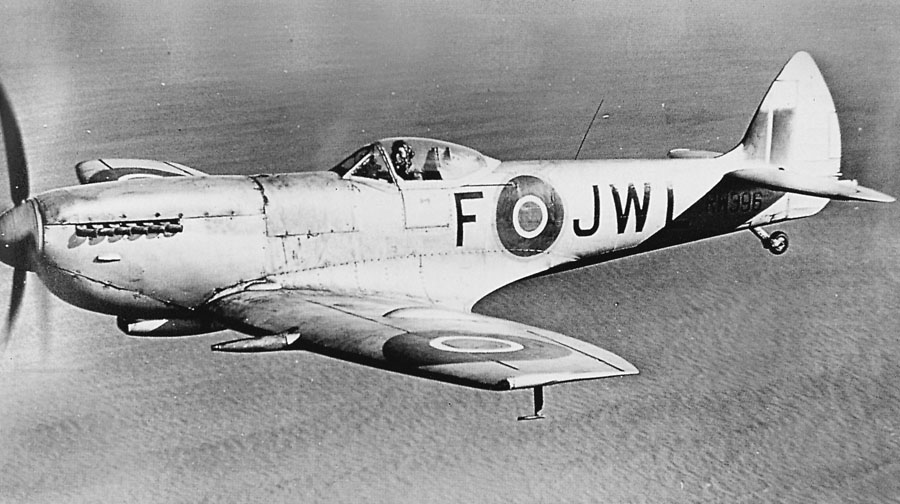
The last batch of Spitfires manufactured at the end of the war were Mk. XIVs; they had the clear-view bubble canopy and were essentially Mk. IXs with a U.S.-built Packard Merlin 266 engine in place of the Rolls Merlin 66. They entered service in large numbers in autumn 1944 and were more than a match for the Luftwaffe. (Photo courtesy of the RAF via author.)
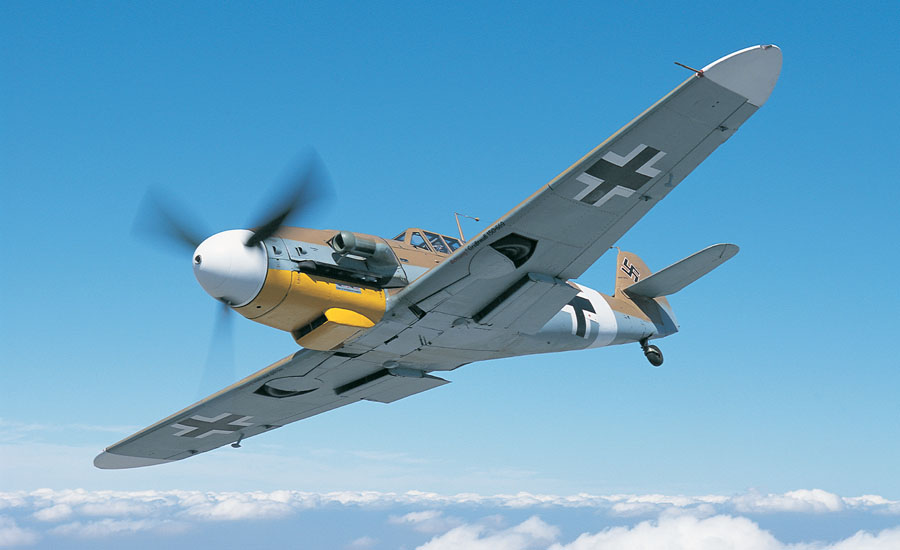
The very vulnerable oil, intercooler, and coolant radiators underneath the Bf 109’s wing helped to make aces of many British pilots. Unfortunately, the Spitfire was similarly vulnerable, and German aces were also plentiful in the Battle of Britain. (Photo by John Dibbs/planepicture.com)
Deliveries begin
The Spitfire’s guns were first fired in anger on October 9, 1939, when they shot down two German Heinkel 111 bombers over the Firth of Forth. This was only a prelude.
Spitfire airframes incorporated two developments that greatly aided pilots. The original ailerons were fabric covered and gave a poor rate of roll at combat speeds. On the Mk. V model, they were modified: a redesigned aerodynamic balance tab and metal covering greatly reduced stick forces and gave it a superb roll rate of more than 140 degrees per second—one of the highest rolling capabilities among WW II fighters.
The Malcolm partial bubble canopy from the Mk. I Spitfire provided very good all-around visibility for five years, and then, in 1944, the full bubble American canopies were available. The British, however, delayed their installation until just after the war’s end—probably to avoid delaying the sorely needed Spitfire deliveries.
Another Spitfire asset of which its wartime pilots were probably ignorant was its 11.5-percent-of-chord main-wing thickness; this gave the Spit a critical dive Mach number of about 0.84—a higher dive speed than any other fighter used in the war.
Most WW II fighters that had wing thicknesses of 15 to 16 percent of chord had a 0.76 top Mach number; this greatly limited their ability to enter evasive dives and often caused them instant and difficult recovery-from-compressibility (transonic) control problems. On April 27, 1944, one RAF photorecon P.R. XI did a planned, instrument-recorded, vertical dive to 0.92 Mach and returned to base without its propeller and engine gearbox. I am sure that the test pilot was pulling on his control stick—“frozen” by compressibility shock waves—with both hands when his Spitfire decelerated through 0.84 Mach and instantly reverted to full control that caused him to make an unintended excessively high-G pullout. Goodbye, prop and gearbox! I have experienced this phenomenon in a Hellcat while exiting the critical transonic compressibility zone.
The Spitfire’s major shortcomings were that it couldn’t carry heavy external stores or large external fuel tanks, and it had a short range. This limited its role as a fighter-bomber. Provisions were made for late Mk. V series Spits to carry one, centerline, 500-pound bomb or a 170-gallon drop tank. In the 5,665 Mk. IXs built, the bomb load was increased to 1,000 pounds with the addition of two wing bomb racks. At this time, American fighters carried more than 2,000 pounds of bombs. Several later Spitfire marques also carried six wing racks for five-inch HVAR rockets. This limited externally carried armament remained until the Mk. XVI model, which appeared just before the war’s end.
Spitfires in the Battle of Britain
Because the Spitfire’s production was started later than the Hurricane’s, only 19 squadrons of them were available for the Battle of Britain, but there were 30 squadrons of Hurricanes. Typically, the 60mph-slower Hurricanes were assigned to attack bombers, and the Spitfires were ordered to a higher altitude to take on the faster Bf 109 fighter escort. Both aircraft were thus in their best fighting arena for this historic battle.
Fortunately, the Spitfire and the Messerschmitt were similarly vulnerable to enemy aircraft shooting from the rear: the oil cooler, coolant and intercoolers that were visibly located in the wings were easy targets for attacking aircraft. When, in 1941, the Focke-Wulf 190 entered the fray with its air-cooled engine and submerged oil coolers, the balance was tipped in favor of the Luftwaffe. The Hurricane and the Luftwaffe’s Heinkel 111 bombers had the same, vulnerable, wing-located cooling systems.
The Navy Spitfire: the Seafire
At the outbreak of WW II, among Allied navies, only the Royal Navy (RN) Fleet Air Arm flew biplanes, and it did so until early 1941. The Seafire production decision was probably not taken sooner because the RAF required all the available Spitfires for the Battle of Britain and the African campaigns.
Although the British RN had 1,620 Seafires before the end of the war, it didn’t do as well on carriers as the 4,313, designed-from-the-ground-up Grumman Wildcats, Hellcats, and Vought Corsairs (delivered to Great Britain under the U.S. Lend-Lease Act). According to RN test pilot Capt. Eric Brown, “The Seafires had very limited range for combat air patrols, and “their deck-landing accident rate resulted in more operational losses than combat successes.”
Its idiosyncrasies notwithstanding, the Spitfire earned its reputation in all of the theaters of the war and was used by many nations long after hostilities had ceased.
By Corky Meyer